Review
De’Longhi Magnifica Evo Next review
A compact one-touch bean-to-cup machine with an automatic milk carafe, 13 drinks and three user profiles. The small carafe and some dialing in are the trade-offs.
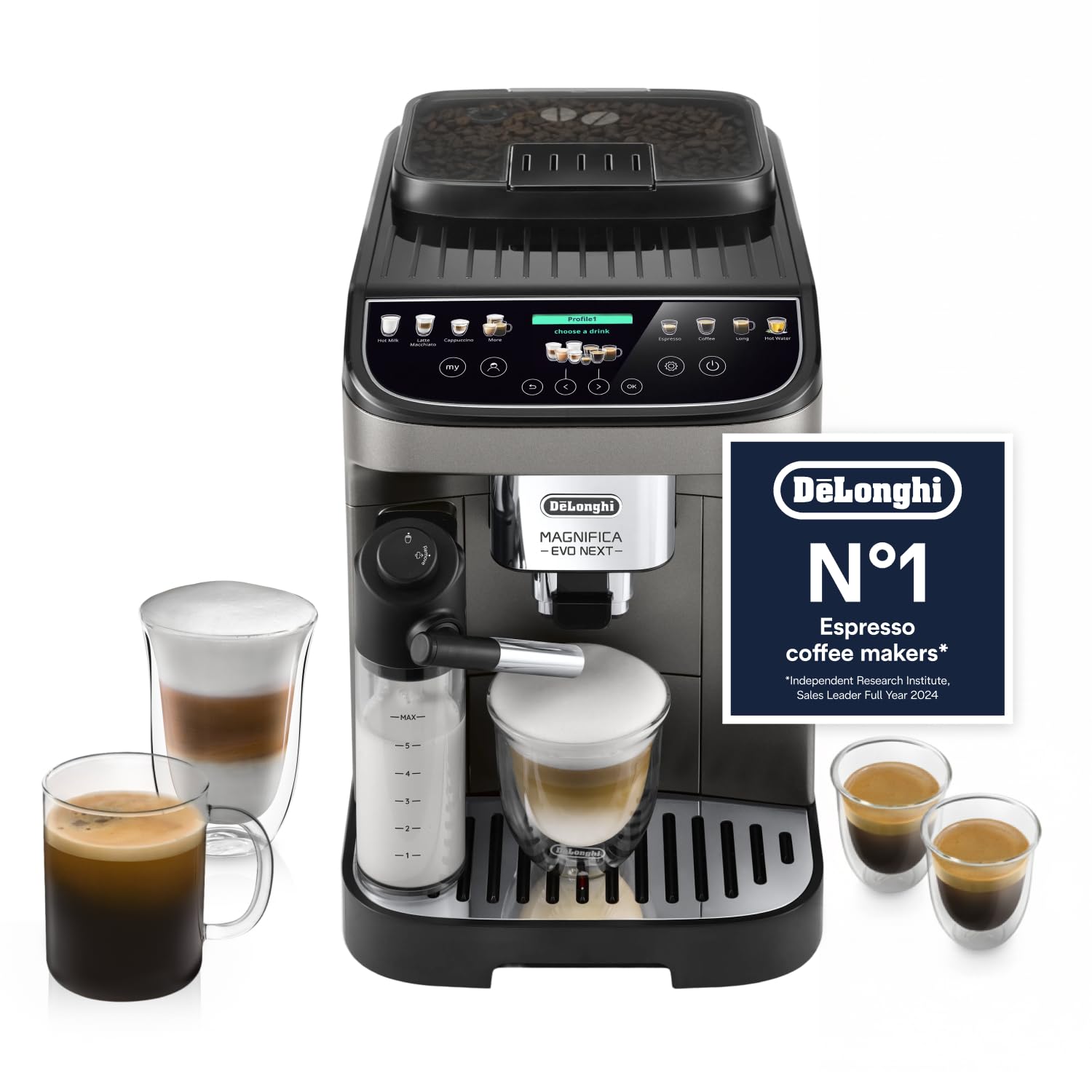
Bean-to-cup
De’Longhi Magnifica Evo Next ECAM312.80.TB
Households that want one-touch milk drinks, with saved settings for up to three people.
Buy it if
Skip it if
Opens Amazon with today's price
De’Longhi has been selling Magnifica machines for well over a decade, and the Evo Next is the latest attempt to put a color screen, an automatic milk carafe and 13 one-touch drinks into the same compact body. It’s one of the best-selling bean-to-cup machines on Amazon UK right now. The question is whether it’s a genuine step forward, or the same reliable machine wearing a nicer screen.
I’ve gone through De’Longhi’s specs, independent reviews and the owner reviews on Amazon UK to work that out.
The short verdict
If you want café-style milk drinks at the press of a button and you’ve got a few people in the house who like their coffee differently, this is one of the easiest machines to recommend in the mid-range. Three user profiles, a milk carafe that cleans itself after every drink, and De’Longhi’s long track record are the big reasons. The catches: the milk carafe is on the small side, the grinder takes some dialing in, and the bean hopper isn’t airtight.
Key specs
| Type | Fully automatic bean-to-cup (model ECAM312.80.TB) |
|---|---|
| Drinks | 13 one-touch recipes |
| Milk | LatteCrema Hot automatic carafe, 280 ml |
| Grinder | Built-in, 13 settings |
| Adjustments | 5 strength levels, 4 sizes, 3 temperatures |
| User profiles | 3 |
| Display | 2.4-inch color screen with touch buttons |
| Pump pressure | 15 bar |
| Water tank | 1.8 liters |
| Bean hopper | 250 g; also takes pre-ground coffee |
| Power | 1,450 W |
| Size (H x W x D) | 36 x 24 x 44 cm |
What you’re actually buying
This is a fully automatic machine. You fill the water tank, the bean hopper and the milk carafe, choose a drink on the screen, and it grinds, brews and adds the milk for you. No tamping, no steam wand, no learning to texture milk.
The milk system is De’Longhi’s LatteCrema Hot carafe. It clips on the front, draws milk up, heats and froths it, and pours it into the cup. When you take it off, you can put it in the fridge with any leftover milk, and the machine runs a quick clean of the spout after each milk drink.
The part I’d pay most attention to is the user profiles. Three people can each save their own strength, size and temperature, so nobody’s undoing anyone else’s settings. Owners mention this a lot, and it’s the feature that separates the Evo Next from the cheaper Magnifica models.
What it does well
- Easy milk drinks. Owners consistently praise the cappuccinos and lattes, and the fact that it takes no skill to get them.
- Saved favorites. One owner has their morning cappuccino set to an extra-large size at strength 3, and gets exactly that at one press. Other people in the house have their own.
- Hot drinks. Several owners specifically say the coffee comes out properly hot, which is a common complaint on other bean-to-cup machines.
- Low-effort cleaning. The carafe and removable parts are dishwasher safe, and the machine rinses itself.
- Compact. At 24 cm wide it takes up less counter space than most machines with an automatic milk system.
Where it falls short
- Small milk carafe. At 280 ml it’s enough for about two milky drinks before refilling, as one owner points out. Fine for a couple, a chore for a family.
- It takes time to dial in. TechRadar’s reviewer found it took a while to master before the espresso was worth the wait. Expect to adjust the grind and strength over your first bag of beans.
- The hopper isn’t airtight. The same reviewer ended up keeping beans in a separate container and topping up as needed. If you drink a lot of coffee this doesn’t matter. If you don’t, your beans will go stale in the hopper.
- Mixed listing reviews. The Amazon listing groups several Magnifica Evo variants together, so some of the reviews you’ll see are for the 7-drink model, not this one. I’ve only used the ones for the 13-drink version where it matters.
A word on “LatteCrema Hot”
De’Longhi’s marketing makes a lot of LatteCrema. Strip away the name and it’s an automatic milk carafe: it heats and froths milk for you. It does that well by most accounts, and it’s genuinely easier to clean than older tube-based systems. But it isn’t magic. The quality of your milk matters as much as the machine, and one owner’s advice is to use proper fresh whole milk rather than the cheapest carton. Plant milks vary; the “barista” versions froth best.
Living with it day to day
Daily: empty the drip tray and grounds container, and put the carafe in the fridge or rinse it. The machine runs a rinse cycle when it turns on and off, so keep a cup under the spout to catch the water.
Weekly: take out the brew unit and rinse it under the tap. It’s removable on De’Longhi machines, which makes them easier to keep clean than some rivals.
Every few months: descale when the machine tells you to. Using the water filter and setting your water hardness reduces how often.
Fit: 36 cm tall, so it slides under most wall cupboards, but leave room above to pour beans into the top-loading hopper. The spout takes cups up to about 14 cm tall.
Running costs
Beans, milk, and the odd water filter and bottle of descaler. Most drinks use somewhere between 7 and 14 g of beans depending on strength, so a 1 kg bag goes a long way: roughly 70 to 140 drinks. That’s far cheaper per cup than capsules once the machine has paid for itself.
What else you’ll need
- Good beans. Fresh beans with a roast date make a bigger difference than any setting. See our guide to the best coffee for coffee machines.
- An airtight container. Worth it if you won’t get through the hopper in a week or two.
- Descaler and water filters. One of each comes in the box; you’ll need replacements.
How it compares
The De’Longhi Magnifica S is the long-running, cheaper model in the same family. It has the same grinder and footprint, but a manual steam wand instead of a carafe, simple buttons instead of a screen, and no user profiles. If you’re happy to froth your own milk, it saves a lot of money.
Philips’ 5400 Series with LatteGo is the obvious rival with an automatic milk system. Its LatteGo milk jug has just two parts and no tubes, which some people find even easier to clean.
Is it worth the money?
Here’s how I’d think about it. You’re paying extra over a basic Magnifica for two things: automatic milk drinks and saved profiles. If more than one person in your house drinks milky coffee, both earn their keep. If it’s just you and you drink espresso or Americanos, a cheaper machine does the same job.
Who should buy it
Buy it if you want lattes and cappuccinos at the press of a button, share the machine with others who like different drinks, and want something compact. Skip it if you make lots of milk drinks at once, or if you only drink black coffee.
Questions people ask
How many drinks can it make?
This version (ECAM312.80.TB) has 13 one-touch recipes. Some Magnifica Evo models have fewer, so check the model number when you buy.
Can it use ground coffee?
Yes. There’s a separate chute for pre-ground coffee, so you can make a decaf without emptying the beans.
Is the milk carafe dishwasher safe?
Yes. It also cleans its own spout after each milk drink, and you can store it in the fridge between uses.
Can it make two coffees at once?
Yes, for black coffees. Milk drinks are made one at a time.
How hot are the drinks?
There are three temperature settings, and several owners specifically say the coffee comes out hot. If it’s too cool, use the hottest setting and preheat your cup.
Bottom line
The De’Longhi Magnifica Evo Next is an easy, well-proven way to get one-touch milk drinks at home, and the user profiles make it a good fit for households where everyone has an opinion on their coffee. Just budget a little time to dial it in, and keep your beans in an airtight tub. For more options, see all bean-to-cup machines.
Last update on 2026-11-20 / Affiliate links / Images from Amazon Creators API
Written by Ben Cleaver